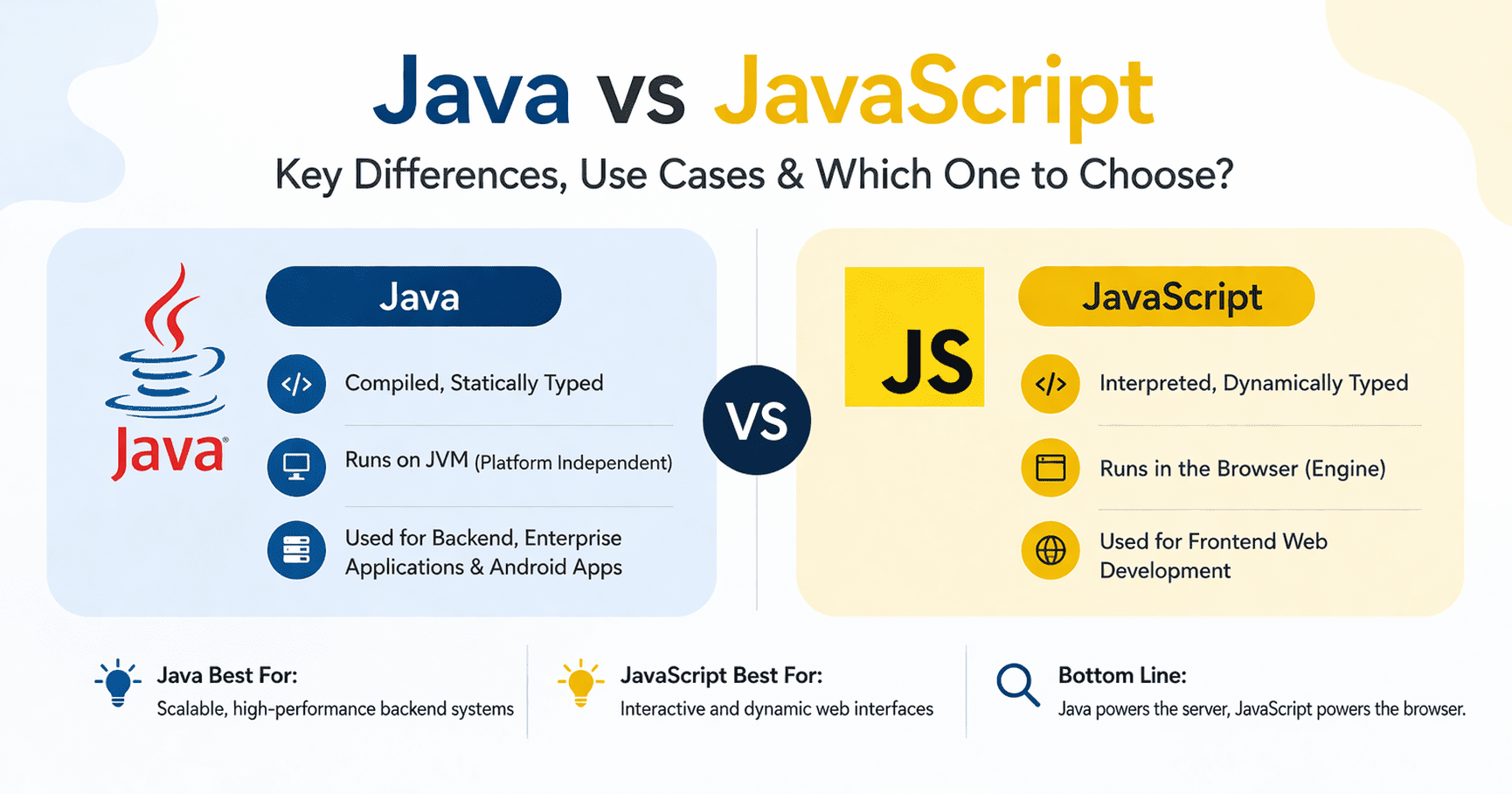
Java vs JavaScript, no one knows that these two are skins of a cat. They are, however, two completely different technologies with completely different purposes. If you are just beginning your programming career or are deciding between the two, you need to be aware of their basic differences.
In this guide, therefore, we will discuss JavaScript vs Java, their features, compare and contrast them, and assist you to make a better choice in your case.
What is Java?
Java is a platform-independent object-oriented programming language released in 1995. It follows the idea of Write Once, Run Anywhere, which is a written code in Java will be able to execute on any machine that has a Java Virtual Machine (JVM).
Key Features of Java
- Strongly typed language
- Principles of object-oriented (OOP).
- Platform-neutral through JVM.
- Scalability and high performance.
- Enterprise application.
Common Use Cases
- Android app development
- Backend systems on an enterprise level.
- Financial software and banking.
- Web 2.0-based applications.
What is JavaScript?
JavaScript is a scripting language, which is a lightweight and interpreted and most commonly used to develop dynamic web pages. It is a web technology core within the World Wide Web, unlike Java, whose Interpreter can execute in web browsers.
Key Features of JavaScript
- Dynamically typed
- Asynchronous and event-driven.
- Runtime: You can run it in your browser or even on the server ( Node. js).
- Easy to learn and flexible
- Functions are functional and object-based programming.
Common Use Cases
- Frontend web development
- Interactive UI/UX
- Real-time web applications
- Backend development (Node.js)
- Mobile apps (React Native, etc.)
Java vs JavaScript: Fundamentals Differences.
The following is a table of comparison between JavaScript and Java programming:
| Feature | Java | JavaScript |
|---|---|---|
| Type | Compiled | Interpreted |
| Typing | Strongly typed | Dynamically typed |
| Execution | Runs on JVM | Runs in browser / Node.js |
| Syntax | Similar to C/C++ | Like C but less restrictive |
| Use Case | Backend, enterprise apps | Frontend, full-stack web apps |
| Performance | Faster (compiled) | Slower (interpreted) |
| Learning Curve | Moderate | Easy for beginners |
| Concurrency | Multi-threaded | Single-threaded (event loop) |
Java and JavaScript: a Comparison.
Syntax and Structure
Java is more boilerplate and is also stricter in syntax. As an example, you must identify what classes and types are.
JavaScript is also more lenient and permissive compared to Java and this will allow beginners to achieve more results faster.
Performance
Java is typically faster as it is compiled into a bytecode and then optimized using the JVM.
As touched upon, JavaScript relies on the browser engine and is therefore slow in certain aspects but it is also quite useful in accomplishing work on the web.
Scalability
Java, due to its strength and sophisticated architecture, is ideal for big enterprise systems.
JavaScript and the application of frameworks such as React and Node are ideal in the creation of scalable, fast web applications. js.
Concurrency
Java has multi-threading and therefore there are many processes that can be run simultaneously.
JavaScripts apply single thread event loop (Asynchronicity) to run tasks.
Example Code Comparison
Java Example
public class HelloWorld {main(String[] args) is the method of this type.System. out. println(Hello, World!). );}}
JavaScript Example
console.log("Hello, World!");
Java is a little more structured, as you can see, and JavaScript is simple.
Advantages of Java
- Very high security and reliability.
- Strong community support
- Superior to massive applications.
- Platform independence
- Improved operation of heavy-duty assignments.
Advantages of JavaScript
- Runs directly in the browser
- Faster development cycle
- Massive ecosystem (libraries and structures)
- Ideal interactive web applications.
- Complete stack support using Node. js.
When to Choose Java?
Choose Java if you:
- desire to develop enterprise-level applications.
- Interested in Android development.
- Want a high performance and scalability.
- Prefer strict type safety
When to Choose JavaScript?
Choose JavaScript if you:
- famp; Sites: 101 Build websites and web apps.
- Be an eye frontend or full-stack developer.
- Like using fast and agile coding.
- To be able to operate using a more advanced framework such as React or Vue.
Java vs JavaScript: Which one is better?
Java vs javascript winner cannot be done in a conclusive way. Your selection will depend on your ambitions:
- Web Development: Python or JavaScript?
- Android or enterprise apps. Better alternative to Java: Java.
- Full-stack dev: JavaScript leads the pack.
In short:
- Java = Stability + Performance
- JavaScript = Flexibility + Speed of Development.
Suggested Reads
FAQs
Is Java and JavaScript identical?
No, they are, in fact, completely different languages with a different purpose though their names resemble each other.
Which is easier, Java or JavaScript?
Generally, JavaScript is simpler to learn as it has extremely loose syntax.
You study JavaScript without studying Java?
JavaScript is self-executable with no prior knowledge of the Java programming language.
Who has superior career prospects?
Both have strong demand. Java dominates the enterprise space, whereas JavaScript takes over web development.
Full Stack Developers, is JavaScript sufficient for backend development?
Yes, with Node. JavaScript is quite a powerful tool, even when used for backend handling with Node.