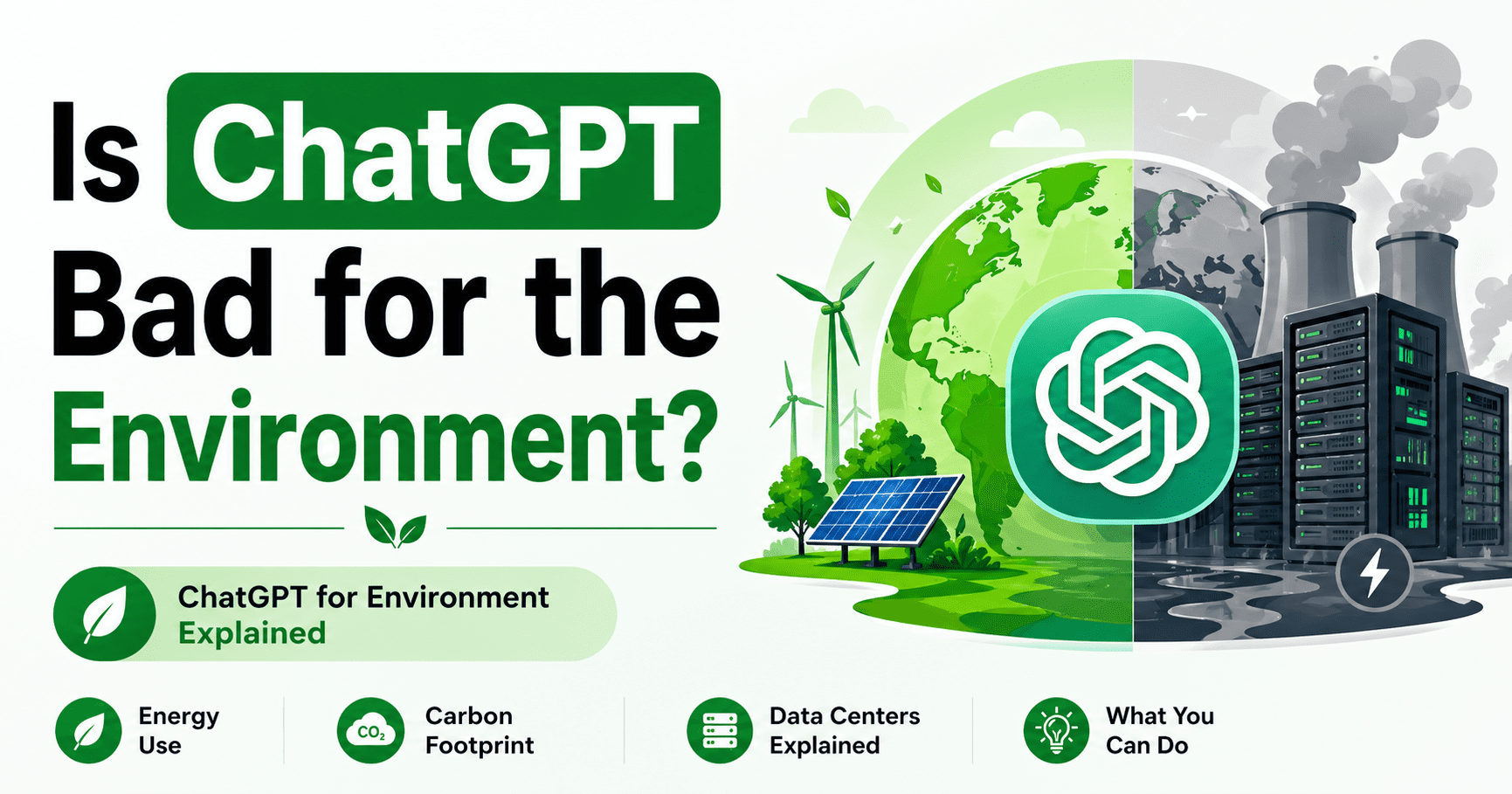
chatgpt for enviroment — this is a question more and more people are starting to ask, and for good reason.
We are living in an era where AI is everywhere. Tools like ChatGPT are becoming part of everyday life, from writing emails to generating code and helping businesses automate tasks through services like
AI Automation Services in 2026.
But behind all this convenience lies a growing concern that many people ignore:
What is the Environmental Cost of AI?
Most people never think about this while typing prompts into ChatGPT.
There’s no smoke.
No noise.
No visible pollution.
But that does not mean there is no environmental impact.
The reality is much more complex.
This article breaks down the truth in a simple and human way so you can understand whether AI tools like ChatGPT are actually damaging the planet.
What Does “chatgpt for Environment” Really Mean?
When people search for “ChatGPT for environment,” they usually want to understand one thing:
👉 Is AI harmful to the environment?
The answer is not simply yes or no.
It’s more nuanced than that.
AI systems do not pollute like factories or cars, but they still require enormous resources such as:
- Massive data centers
- Continuous electricity usage
- Advanced hardware and GPUs
- Cooling systems running 24/7
These systems are incredibly power-hungry.
As modern AI becomes more advanced, especially compared to articles like
GPT-5.5 vs Opus 4.7 the amount of computing power behind these models also increases.
The Hidden Infrastructure Behind AI
Every time you ask ChatGPT a question, your request travels to powerful servers inside large-scale data centers.
These centers:
- Run all day and night
- Use thousands of GPUs
- Require constant cooling
- Consume huge amounts of electricity
Most modern AI infrastructure depends heavily on technologies such as
Docker Container 2026 and Linux-powered server environments are discussed in
How Does Linux Outshine Windows 2026.
Why Cooling Systems Matter
Data centers produce a massive amount of heat.
Without cooling systems, servers would overheat quickly.
To prevent this, companies use:
- Water-based cooling
- Industrial air conditioning
- Specialized thermal management systems
This increases both:
- Electricity consumption
- Water usage
So the environmental cost is larger than most people imagine.
Comparing AI Energy Consumption
Here’s a simple comparison to help visualize the impact:
| Activity | Energy Usage | Environmental Impact |
|---|---|---|
| Sending an email | Extremely low | Minimal |
| Google search | Low | Low |
| ChatGPT query | Medium | Moderate |
| Training large AI models | Very high | High |
The biggest environmental issue is not usually asking ChatGPT questions.
The largest impact comes from training AI models.
The Real Problem: AI Training
AI systems operate in two major stages:
- Training stage
- Usage stage
The training stage is where most environmental costs happen.
Training large AI systems may require:
- Millions of kilowatt-hours
- Huge computational clusters
- Massive GPU farms
- Significant carbon emissions
This is why discussions around
AI Model Safety are becoming increasingly important in the tech world.
Even after training finishes, AI usage still consumes energy continuously.
Why People Are Concerned
Let’s be honest.
The ChatGPT environment debate is as emotional as it is technical.
People are asking questions like:
- Is convenience harming sustainability?
- Are tech companies hiding the real environmental cost?
- Is AI growth becoming too fast?
These concerns are understandable because AI adoption is accelerating globally.
Articles discussing future AI ecosystems like
LangChain vs LangGraph 2026 show how rapidly AI infrastructure is expanding.
Is ChatGPT Worse Than Traditional Industries?
Not necessarily.
Let’s compare:
Traditional Industries
Factories and transportation directly burn fuel and release emissions into the atmosphere.
AI Systems
AI mostly consumes electricity.
If that electricity comes from renewable sources, the environmental impact can be reduced significantly.
So in many cases, AI may actually be less damaging than older industrial systems.
However, the problem is scale.
AI usage is growing extremely fast.
Can ChatGPT Actually Help the Environment?
This is something many people overlook.
AI is not only part of the problem — it can also become part of the solution.
Ways AI Can Support Sustainability
AI can help with:
- Reducing energy waste in buildings
- Predicting climate patterns
- Improving transportation efficiency
- Reducing paper usage
- Supporting remote work
Many companies using
AI Automation Services in 2026 are already using AI to reduce operational waste and improve efficiency.
Developers are also building smarter AI systems using frameworks discussed in
MCP Library Full Guide and modern AI orchestration tools.
The Responsibility of Big Tech Companies
This is the biggest issue.
Tech companies are responsible for:
- Building energy-efficient data centers
- Using renewable energy
- Designing efficient hardware
- Reducing carbon emissions
Many companies are investing heavily in:
- Solar energy
- Wind energy
- Green computing technologies
Infrastructure optimization methods used in modern
CI/CD Tools 2026 pipelines are also helping companies improve operational efficiency.
But people still wonder:
👉 Is it enough?
What You Can Do as a User
You may feel powerless, but you are not.
Use AI More Mindfully
You can reduce unnecessary AI usage by:
- Avoiding repetitive prompts
- Combining multiple questions together
- Using AI for meaningful tasks instead of endless curiosity browsing
The goal is not fear.
The goal is awareness.
You do not need to stop using ChatGPT.
You simply need to use it responsibly.
The Bigger Picture
The truth about ChatGPT and the environment is this:
👉 AI is neither completely harmful nor completely innocent.
AI is part of a much larger system involving:
- Energy production
- Infrastructure
- Human behavior
- Technology growth
Blaming AI alone oversimplifies the issue.
The future depends on how humans choose to build and use technology responsibly.
Final Thoughts
So, is ChatGPT bad for the environment?
The honest answer is:
👉 It does have environmental impacts — but the story is complicated.
Yes, AI uses significant energy.
Yes, training large models consumes enormous resources.
But AI can also improve sustainability and reduce waste in many industries.
The real goal should not be stopping AI.
The goal should be building greener AI systems for the future.
That responsibility belongs to:
- Users
- Developers
- Tech companies
- Governments
Because technology should not grow at the expense of the planet.
Suggested Reads
FAQs
Does daily use of ChatGPT negatively affect the environment?
Daily use has some environmental impact, but it is relatively small compared to major industrial sectors.
Why does AI consume so much energy?
AI training requires powerful GPUs, massive datasets, and continuous server operations.
Can AI become environmentally friendly in the future?
Yes. Renewable energy and more efficient AI systems can reduce environmental impact significantly.
Should I stop using ChatGPT to protect the environment?
No. Responsible and mindful usage is more important than avoiding AI entirely.
Does ChatGPT use more energy than Google Search?
Typically yes, although the difference per query is still moderate overall.
What is the biggest environmental problem with AI?
The training process for large AI models consumes the most electricity and computational resources.