Intorduction
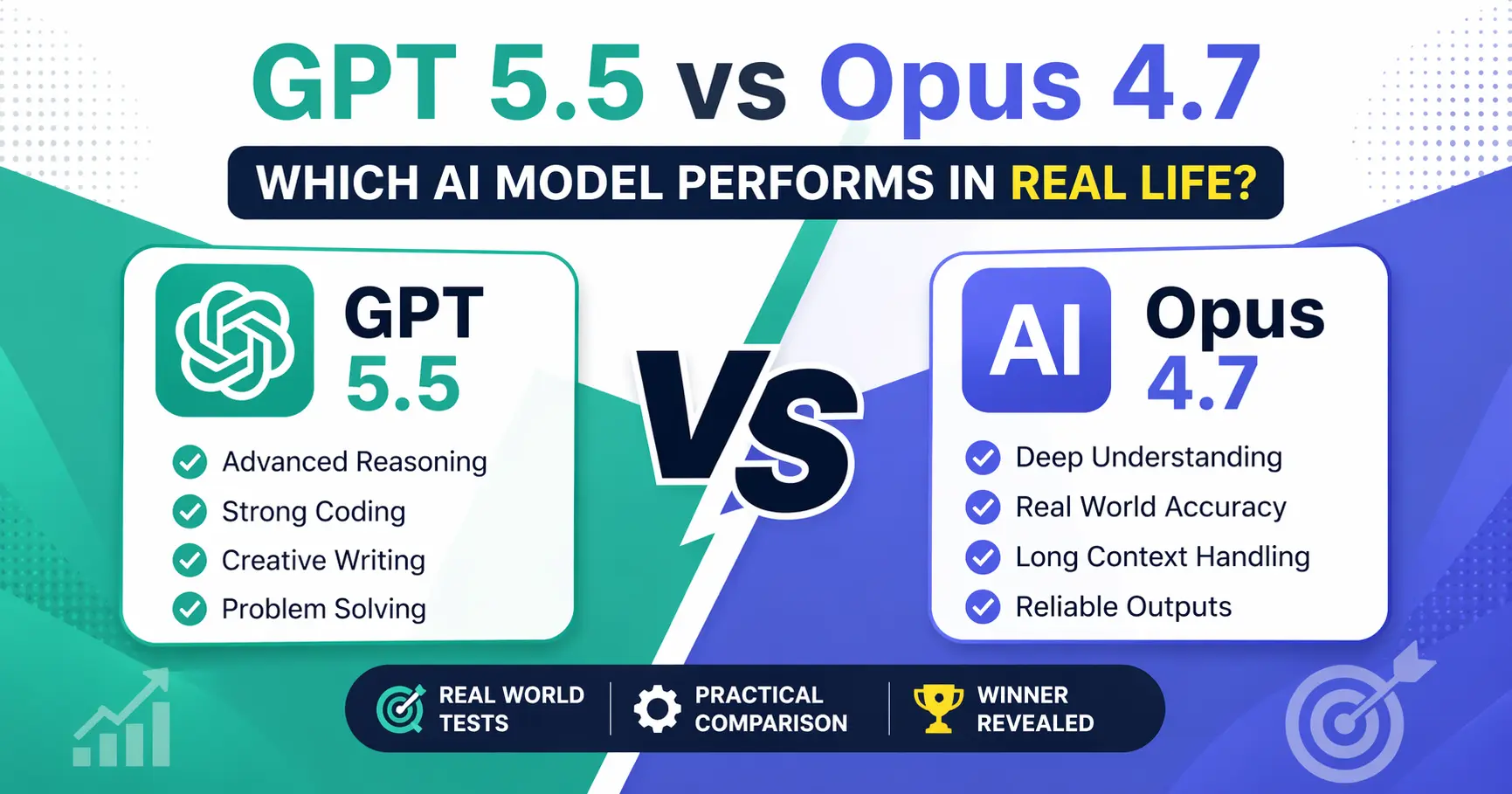
GPT 5.5 vs Opus 4.7 is not a mere AI comparison, but a choice that can directly affect your workflow, costs, and productivity.GPT 5.5 vs Opus 4.7 – find out which AI model is quicker, less expensive, and more beneficial to real-life activities, similar to code, automation, and content generation
As a developer, founder, or creator, you must have experienced this pain:
You model on hype, you pick a model on hype…
Hours spent in incorporating it…
And then find out it is slower and/or more costly and/or not as reliable.
That’s frustrating.
As OpenAI is introducing GPT 5.5 vs Opus 4.7, and an in-progress Anthropic is releasing Opus 4.7, the race is as close as ever. Benchmarks are awe-inspiring, but it is real-world performance that counts.
So, as opposed to mere theory, this article dissects:
- Speed
- Cost
- Output quality
- Practical use cases
All founded on real experiments and observations.
GPT 5.5 vs Opus 4.7 — What’s New?
GPT 5.5 Overview
GPT 5.5 is billed as the most advanced model to date from OpenAI. However, the twist is here:
It is not only a matter of being smarter but also of doing more with less.
Key improvements:
- Enhanced thinking and independence.
- Reduced use of output tokens.
- Faster execution
- Better use of tools (workflow, multi-agent, coding, etc.)
If you are exploring modern AI workflows, you may also like AI Automation Services in 2026 and LangChain vs LangGraph (2026).
Opus 4.7 Overview
Opus 4.7, in its turn, is notorious because of:
- Good logical thinking in intricate tasks.
- Increased context window (~ 1M tokens).
- Long-form processing stability.
Still, it reigns in some fields such as real-world coding competencies (e.g., SWE tasks).
Comparison of performance (Real Experiments)
Rather than using marketing claims, real tests were carried out in various tasks:
Experiment Breakdown
| Task | GPT 5.5 Result | Opus 4.7 Result |
|---|---|---|
| Personal Web Site | Quicker + less expensive | Slower + expensive |
| Solar System Simulation | Good with flaws UI | Improved graphics |
| Space Shooter Game | Smooth gameplay | Buggy experience |
| Ecosystem Simulation | Functional problems | Logic problems |
Developers comparing frameworks and tooling can also read Next.js vs React (2026) and Claude Code vs Cursor (2026).
Speed – In which GPT 5.5 triumphs
Real Numbers
GPT 5.5 overall time: around 20 minutes.
Total runtime of Opus: 4.7, around 40 minutes.
That’s 2x faster.
Why It Matters
If you’re:
- Running automation pipelines
- Building SaaS products
- Generating code repeatedly
Speed = money.
The fact that it takes twice as much time to have results is not only annoying, but also kills productivity.
Cost – The Sunken Cost
Pricing Reality
GPT 5.5: Increasing price per token.
Opus 4.7: A little less expensive output tokens.
BUT…
There is no Efficiency in Tokens
GPT 5.5 uses:
- Fewer output tokens
- More efficient responses
Result:
Total cost usually results in lower or comparable costs, even at a higher price.
Example Insight
Across experiments:
- GPT 5.5 was lower by an average of $3.
- Only used a lot fewer output tokens.
Quality of the output: 0 -100% black and white
Where GPT 5.5 is the Strongest
- Smooth gameplay logic
- Better structured responses
- Quick decoration of the original image
Still Opus 4.7 Wins
- Visual design consistency
- Some complex simulations
- Long-context understanding
The Reality
No definite winner.
It is based on your application:
- Coding → GPT 5.5
- Design-heavy tasks → Opus 4.7
- Long context → Opus 4.7
For developers improving AI development workflows, MCP Library Full Guide and DevOps Practices in 2026 are also useful resources.
There exist major differences that make a difference
1. Token Efficiency
GPT 5.5:
- Fewer output tokens
- More concise answers
Opus 4.7:
- More verbose
- Higher output cost
2. Autonomy
GPT 5.5:
- More adept when dealing with ambiguous cues.
- Takes initiative
Opus 4.7:
- Needs clearer instructions
3. Context Window
GPT 5.5: ~400K tokens
Opus 4.7: ~1M tokens
When you are analysing large codebases → Opus wins.
4. Speed vs Stability
GPT 5.5: Fast + efficient
Opus 4.7: Softer yet occasionally more refined.
Real Pain points Developers Realistically Experience
Let’s be real.
The majority of comparisons do not take into consideration what actually annoys the users:
Pain Point #1 – It is too expensive
Until you find you are saving money… when:
- Output tokens explode
- API bills spike
GPT 5.5 is an efficient solution to this.
Point of Pain #2 – Too long: It is too long.
Taking 10-15 minutes per activity??
That kills::
- Momentumm
- Creativityy
- Productivityy
GPT 5.5 is much faster.r.
Pain Point # 3- It does not know my prompt
“You put a thing indeterminate, and:
- The model is overly curious.
- Or yields no fruitful service.
GPT 5.5 is more tolerant of ambiguity.
Pain Point #4 Pain in the It Breaks in Real Projects
Benchmarks don’t show:
- UI glitches
- Logic bugs
- Broken flows
The two models are still not doing so well here – they need to be iterated.
Which of the Two to Use?
Choose GPT 5.5 if:
- You are speedy-fussed.
- You desire cheaper real-world price.
- You develop applications or automations.
- Your initial productions are wanting.
Choose Opus 4.7 if:
- Long context (massive files) is required.
- You are a design quality-concerned person.
- You deal with complicated documents.
Conclusion / Final Thoughts
The question of which model is better, GPT 5.5 vs Opus 4.7, is not the issue.
It’s about:
Which model suits your particular use?
From real-world testing:
- GPT 5.5 is more efficient and faster.
- Opus 4.7 takes a stand to this day in context and design assignments.
The smartest approach?
Never marry a model.
Apply both to the best of both worlds.
In 2026, it is not the tool, but how you use it that will be the real benefit.
Suggested Reads
- Claude Code vs Cursor (2026) What is the Best AI Coding Assistant?
- AI Automation Services for Modern Businesses in 2026: Boost Efficiency & Growth
- OpenAI Official Website
- Anthropic Official Website
- OpenAI API Documentation
FAQs
Q1: Is GPT 5.5 better than Opus 4.7?
Not universally.
GPT 5.5 is more efficient and the fastest, whereas Opus 4.7 performs better in the long-context tasks.
Q2: Which of the two models is cheaper?
Lower prices in GPT 5.5 can be offset by lower usage of tokens in practice, although the product is priced higher.
Q3: Which is more suitable for coding?
GPT 5.5 tends to be more efficient and productive at coding and provides quicker and easier code.
Q4: Does Opus 4.7 continue to have benefits?
Yes, especially in:
- Long documents
- Context-heavy tasks
- Visual consistency
Q5: Do I want to entirely move to GPT 5.5?
Not necessarily.
The most appropriate approach is to employ both models based on the work task.
2 thoughts on “GPT 5.5 vs Opus 4.7 – Full Comparison”